
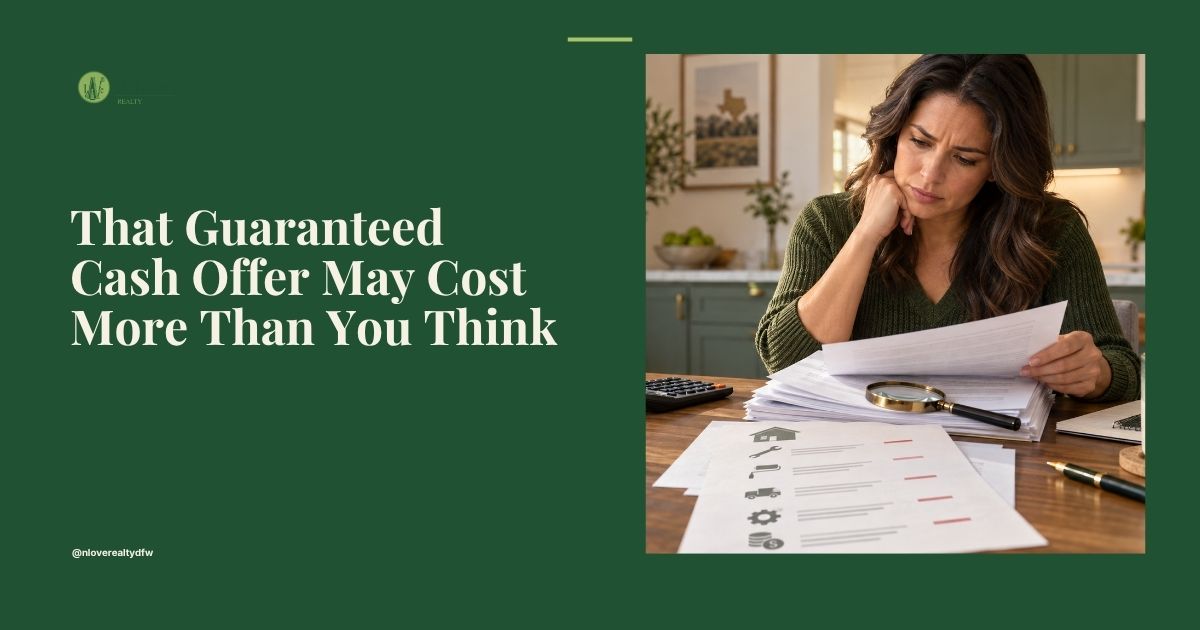
Fast and Easy Can Be Expensive
You have probably seen the advertisements promising a guaranteed cash offer with no repairs, no showings, and a closing date that works around your schedule. It sounds easy, especially if you need to sell quickly or do not want to deal with the traditional selling process.
A guaranteed cash offer is not automatically a bad deal, but it may not be as good as it first appears. Before you sign anything, slow down and look beyond the advertised offer. The number that matters most is not the one at the top of the page. It is the amount you will actually receive at closing.
The Offer Is Not What You Take Home
A cash buyer may start with an offer that gets your attention, but that amount can change once fees and repair deductions are added. Some companies charge service fees, administrative fees, transaction fees, or other costs. They may also lower the offer after inspecting the home and identifying repairs they say are necessary.
Ask for the complete offer in writing, including the purchase price, every fee, estimated repair deductions, closing costs, and your expected proceeds. If the buyer cannot clearly explain where the money is going and what you will receive, do not sign until you have answers. A strong opening offer does not mean much if the final amount is considerably lower.
You Could Be Leaving Equity on the Table
Investors and cash-buying companies purchase homes to make money. They may renovate the property and resell it, or they may keep it as a rental. Either way, their offer has to leave room for expenses, risk, and profit. That room often comes out of the seller’s equity.
You could receive less than your home might bring if it were properly priced, marketed, and exposed to more buyers. Before accepting a cash offer, ask a real estate agent to prepare a market analysis and seller net sheet. Then compare what you could actually walk away with from each option, not just the offer prices. A higher offer with heavy fees and deductions may leave you with less money than a lower offer with cleaner terms.
The Fees May Not Look Like Fees
A company may advertise that you will not pay a real estate commission, which can sound like a major savings. But if the company offers far less than the home could bring on the open market, you may avoid one visible expense while giving up much more in equity.
This is not just a hypothetical concern. The Federal Trade Commission said Opendoor often offered sellers less than market value and charged more than its advertising led them to expect. The company paid $62 million as part of the FTC’s action, with the money used to provide refunds to affected sellers. The lesson is simple: do not focus on one fee while overlooking the full financial picture.
Watch What Happens After the Inspection
Some cash buyers make an attractive offer before seeing the property. Once the seller is under contract, the buyer inspects the home and lowers the price based on repairs. By that point, the seller may have packed, made moving plans, or stopped considering other buyers. Walking away feels harder, and some companies may use that pressure to their advantage.
Read the contract carefully before you commit. Find out whether the buyer can change the price, cancel without consequences, or assign your contract to someone else. Ask how repair deductions will be calculated and whether you will receive written estimates. The first offer means very little if the buyer has several ways to reduce it later.
Pressure Is a Warning Sign
A legitimate buyer should give you time to review the offer, ask questions, and speak with your own professionals. Be careful if someone says the offer expires immediately, discourages you from calling a real estate agent or attorney, or pressures you to sign documents you do not understand. The Consumer Financial Protection Bureau identifies pressure to act quickly as a common warning sign of possible fraud. The Federal Trade Commission also warns that some scammers have persuaded homeowners to sell for far less than comparable homes or sign over their deeds.
Never transfer ownership of your home based on a verbal promise. Be especially careful with anyone who says you can sell the property, remain in the home as a renter, and easily buy it back later. The FTC warns that sale-leaseback agreements may come with high fees, rising rent, and the risk of eviction. If a deal is difficult to understand or someone does not want you to have it reviewed, that is a good reason to pause.
Your Agent May Have Another Cash Option
If you want a quick sale, talk with a real estate agent before accepting an advertised cash offer. Many agents work with reputable local investors who may also purchase homes with cash. These investors may be willing to buy the property in its current condition and close quickly without charging the service and administrative fees used by some larger companies.
You should still ask for proof of funds, review the contract, and compare your expected proceeds. A local investor’s offer may be lower than what your home could bring on the open market, but without additional fees, it could leave you with more money than another cash offer. A good agent can help you compare a traditional sale with local investor offers so you can decide which option gives you the right balance of speed, convenience, certainty, and proceeds.
Convenience Has Value
There are situations when a legitimate cash offer makes sense. Maybe the home needs extensive repairs, you inherited the property, you need a fast closing, or you simply do not want to prepare the home for showings. Convenience has value, and choosing the easiest option is not necessarily the wrong decision.
You just need to understand what that convenience is costing you. Ask whether the buyer can prove they have the cash, whether they are purchasing the property in its current condition, how much earnest money they will deposit, and what happens if they back out. A cash offer is only valuable if the buyer can actually close under the terms you were promised.
Compare Before You Commit
Before signing anything, find out what your home may be worth on the open market. Ask what it would take to prepare the property for sale, how long the process could take, and what your estimated proceeds may be after expenses. Then compare your options side by side, including final proceeds, fees, repair responsibilities, closing timelines, and the certainty of each transaction. A good real estate agent should explain the numbers honestly, even if the cash offer turns out to be the best choice for your situation.
Your home may hold years of equity. Do not give part of it away simply because an advertisement made selling sound easy. Read the fine print, verify the buyer, and understand the full deal before you sign. The goal is not just to sell your house. It is to protect what you have built and walk away knowing you made the right decision for you.